Hasibul Islam Mozumder

Founder · ElectrONIK Lab Service Engineer, working on ASMPT/SIPLACE lines since 2021

24 years old. ASMPT certification courses, almost all held at the ASMPT site in Munich. Hands-on work for clients across Italy since 2021.

I work for those who can't afford missteps: automotive groups, high-tech electronics, manufacturers with strict traceability requirements. And for those who want a technician who answers to one person only — the client.

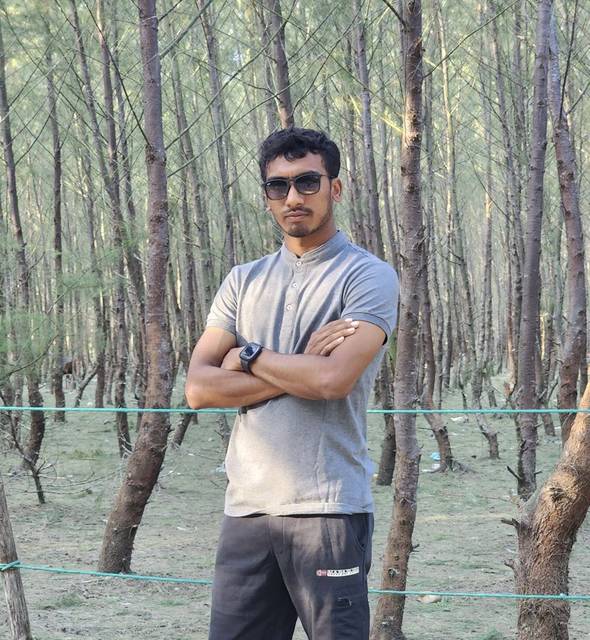
Hasibul Islam Mozumder, founder of ElectrONIK Lab
HM
ASMPTcertification courses
2021first SMT assignment
Munichtraining

05:00

January 2026. For four years the alarm had gone off at five in the morning, with a production line to reach somewhere in Italy or abroad. Now it was silent.

Those were the hardest months of my adult life. Unemployed on paper, but never idle: every day I studied something, tried something out with my hands. I've always been like that. And all the while I kept thinking about a single question: what do I do now? I tried the most obvious route. I signed up for the Politecnico di Milano admission test and didn't pass it. While I was preparing to take it again, I realised that this wasn't the answer: my work changes every year, and to keep up with it I had to be able to learn as fast as it changes. Neither a classroom nor another employer would have let me do that.

To understand how I got out of it, we have to go back. To an 11-year-old boy, sitting in a classroom where he didn't understand a word.

Two languages, one root

I was born in Comilla, Bangladesh, into a Mozumder family: an educated family, where studying mattered. I did my first years of school in the countryside and the last ones in the city, up to the primary school certificate at the end of fifth grade. I still read and write Bengali.

At 11 I moved to Italy with my mother and my brother. On the atlas I could find Italy, Rome and, more or less, Milan. Nothing else. I didn't know how to say "buongiorno".

Learning Italian was like being born again into a new world, but this time already knowing how to walk. I already had a language, a culture, a way of relating to other people. In front of me I had two languages, two cultures, two religions, two histories thousands of years long. Instead of looking at the differences, I looked for what they had in common.

And I found more than I expected. Bengali and Italian are distant relatives: both come from Indo-European, the language spoken about six thousand years ago from which almost all the languages of Europe and many of those of India descend, from Latin to Sanskrit. That is why the Italian "due" (two) is dui in Bengali, "tre" (three) is tin, "nove" (nine) is noy, and "nome" (name) is nam. Two languages born thousands of kilometres apart, with the same roots.

BengaliItalian
duidue
tintre
noynove
namnome
kedaracadrega

The nicest surprise, though, I found right here in Brianza. In Bengali a chair is kedara; in the Brianza dialect it is cadrega. It's no coincidence: both come from the Latin cathedra. It reached Lombardy directly; it was taken to Bengal by Portuguese merchants, who called it cadeira, almost five hundred years ago. The same chair went around the world to reach the two homes of my life.

Maths I decoded through logic, everything else through stubbornness. Within two months I could follow the lessons.

I have carried two things with me ever since. The first: between me and someone who speaks another language there are far fewer differences than it seems. The second is a method: when I don't understand something, I look for what it has in common with what I already know, and I study it until it's clear. Today I am Italian and Bengali, and I know both cultures from the inside, because I have lived them.

Current, control, network

Mozumder is a name that comes from Persian: in Bengal it meant the person who kept the accounts and records for the administration, in the days of the Mughal Empire. In my family, on both my mother's and my father's side, it was a trade for generations, and many of my uncles still do it. As a child I wanted to be an accountant too.

In Italy, though, the first years were hard, as they were for so many families who had just arrived. After middle school at the Traversi school in Meda, I was advised to learn a trade, so that I could start working early instead of spending years over books. That is why I chose vocational training at CFP Sandro Pertini in Seregno, as an electrical operator. At 16 I did my first internship at an electrical installation firm in Meda: residential wiring, electrical panels, connecting an industrial motor.

From then on, school and work always went together. At 16 I did home deliveries after school, and I carried on at 17 too. Then, between 18 and 19, Covid arrived: dark years, for me as for everyone.

Technology, in fact, had got hold of me long before. I took apart phones, PCs, radios, remote-controlled cars and planes. I tried things somewhat at random, because there was no one to explain to me how they worked. School explained it to me, but only in part: residential installations, a three-phase motor, little else. I wanted to understand home automation, automation in general, how you control an entire machine.

When I saw that the syllabus for the following years was the same as what I had already done, I changed course. At the end of July I found the fourth-year course for industrial automation technicians at Consorzio Desio-Brianza. The class had 20 places and 19 were already taken: I was the last one in. There I studied robotics, PLCs, computers and networks.

Then the work placement, at the start of 2020, at a company in Meda that builds electrical panels for industrial machines. I worked on the panel for a line that makes glass bottles for carbonated drinks. I did it from start to finish: measurements, cutting the bracket, fitting relays, circuit breakers, terminal blocks, the PLC and the network switch, wiring, testing, then programming the PLC and testing the program. When I saw the machine respond to what I had built, that lit the fuse.

I did my fifth year at IPSIA Enzo Ferrari in Monza: maintenance of industrial installations, medium- and low-voltage switchboards, electrical power distribution. Meanwhile I was working, because enrolling at the ITIS took money my family didn't have. In the summer of 2021 I was installing antennas and equipment at telecommunications radio sites. Travelling for work, I came across the world of SMT lines, and that's where everything changed.

One board, one component

In September 2021 I joined a service company for ASMPT/SIPLACE SMT lines as a technician. It changed my life. For more than four years I travelled from one production line to the next, in Italy, Switzerland, France, Austria and Malta, for small manufacturers and for multinational groups, often in sectors where every board produced has to be traced. On the other side of the table there were almost always heads of production, managers or owners: I had to explain to them what had happened and when the line would be running again.

I started as a hardware technician: SIPLACE machines, DEK screen printers, ASYS systems, new line installations, maintenance, troubleshooting. I studied the software on my own, until in the last year and a half my work became mostly systems work: SIPLACE Pro, WORKS Software Suite, the line's Windows servers, material traceability from goods-in to delivery. Usually those who know the hardware don't touch the software, and those who know the software don't open the machine. I did both. Between 2022 and 2025 I took the ASMPT certification courses, almost all of them in Munich.

That is where the method I learned at 11 became a trade. To find a fault I swapped parts between one machine and another, looking for what they had in common and what they didn't. When the fault was on a board, the procedure was always the same: the whole board was replaced. Once the machine was running again, though, I would take my time with the board I had removed, with the circuit diagram in front of me. Many times the fault was a single component: a resistor, a capacitor, a ferrite, a chip in a QFP package, an EEPROM that no longer responded. Replacing just that one would have been enough, but I wasn't authorised to do it. And every time, a board that still worked was put aside for a part worth a few cents. It was absurd, and it stuck in my mind.

I have always set myself one rule: never leave a client with the line down. If a fault couldn't be fixed straight away, I isolated it and kept the machine running safely until the part arrived. Over time I started introducing new tools and methods and sharing them with my colleagues, so that we could all use them.

Leaving at 5 in the morning, back in the evening, 2,500 to 3,000 kilometres a month. That's when I understood I wanted a job where the result depended on me.

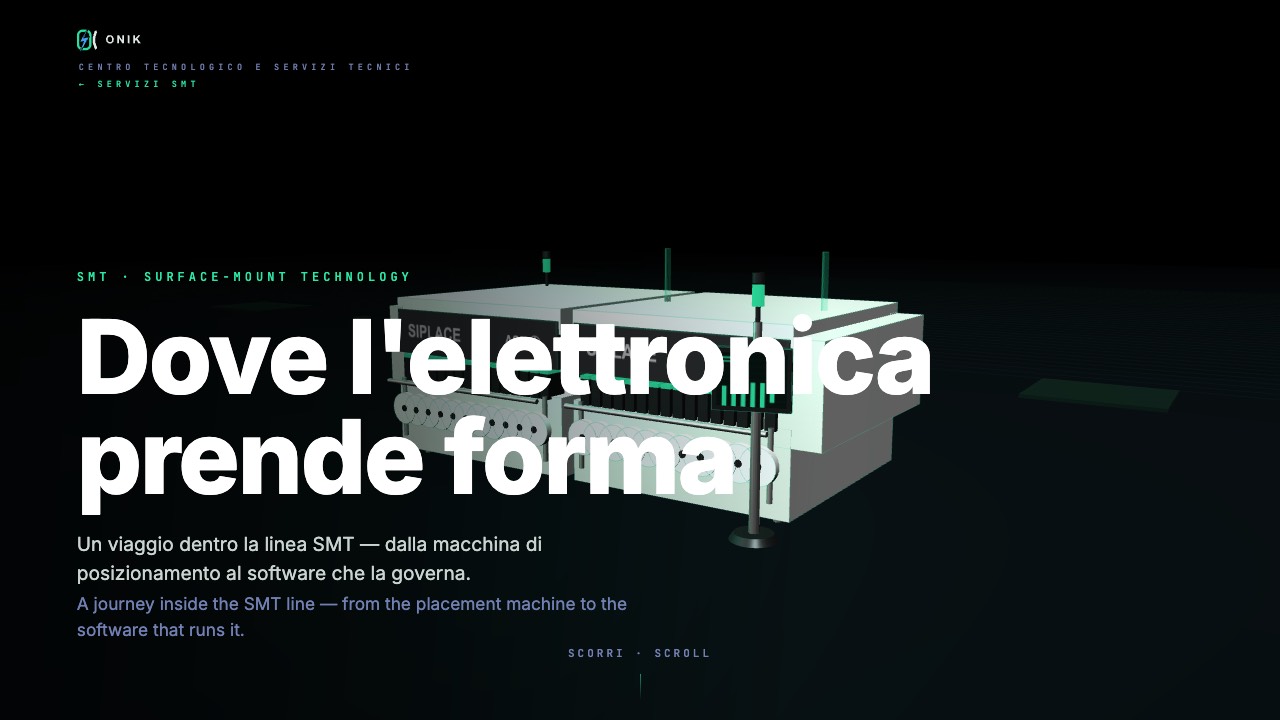
Still preview of the 3D experience: a placement machine on the SMT line

Explore the SMT line

A 3D journey inside the line: from the placement machine to the software that runs it.

The inventory

Back to that winter. In December 2025 I was let go, and in the months that followed I did what I do with a broken machine: an inventory of what still works.

  • Finding the burnt-out component on an axis control board.
  • Programming a line.
  • Aligning the guides of an axis with coplanarity tools.
  • Working hands-on with a power panel.
  • Configuring the server that traces every board produced.

Lined up together, it was more than I thought. And every fault, at heart, was the same problem: a powered system, a part that stops responding, someone who has to work out which one. Whether it's an SMT line, a PC or a phone, the method doesn't change.

In April 2026 I hear on the TV news about funding for young people starting a business. I check that it's true: it's Autoimpiego Centro-Nord, the programme run by Invitalia and co-funded by the European Union. I study it the way I used to study machine manuals, line by line, until it's clear. I write the project, the investment plan and the application. On my own, without consultants. In May I register a VAT number, still inactive, because that's the condition for taking part in the call, and I follow the training course the programme requires. On 7 August 2026 I submit the application.

Then the wait. Months without knowing whether the project would be approved, and I used them to build everything else, without a single euro of funding: the website, a management system, the market analysis. And the first real clients, to put the lab to the test critically and transparently and to build a portfolio and a client base from scratch.

On 23 September 2026 the decision arrives: the project is approved.

Along the way I wasn't entirely alone. I joined Confcommercio, where I found people who are keen to help young people who are starting out.

The programme's funds are for the lab's tools. The rest I put in myself: my savings, my time and all the work it takes to make it run.

Iron and code

ElectrONIK Lab was born right there, in that waste: a lab where a board, a phone or a PC is repaired by finding the faulty component, instead of throwing the whole part away.

But it isn't just a repair bench. On the lines I learned two trades that usually stay separate: the most delicate mechanical and electronic work, and the software that makes everything run. Iron and code. ElectrONIK Lab keeps them in the same place: the hardware gets repaired, the software gets installed and integrated, the whole system gets looked after. It is based in Meda, and it brings the same method to three worlds.

Three things rarely found together

I'm not asking you to trust me just because I say so. I'm asking you to look at the facts.

01 — Real specialisation

The ASMPT certification courses aren't a showcase

They're the result of a habit: every software release, every new module, every update I study before it becomes a problem in the field. Industrial software evolves constantly — those who stop training stop being useful.

02 — Dual nature

Hardware and IT systems, the same person

Few technicians in Italy can do both. Those who know the machines often never touch a Windows server; those who manage servers have never seen a pick & place from the inside. I live in the grey area between the two worlds — where the most expensive problems are born.

03 — Independence

I don't answer to the sales channel

I don't sell new machines, I don't sell branded spare parts, I have no commission on what I recommend. What I tell you is what I really think — even when it means telling you that the machine you have doesn't need replacing, it just needs fixing.

My journey, year by year

← Swipe horizontally to navigate →

2013

Arrival in Italy

From Comilla, at 11, with my mother and my brother.

2016–19

Electrical operator

CFP Sandro Pertini, Seregno.

2018

First internship, at 16

An electrical installation firm in Meda.

2019–20

Industrial automation

Consorzio Desio-Brianza; work placement on electrical panels and PLCs (early 2020).

2020–21

Fifth year at IPSIA Enzo Ferrari, Monza

Industrial installations, medium- and low-voltage switchboards.

2021

Summer on telecom radio sites

In September, the SMT world.

2021–25

Technician on ASMPT/SIPLACE lines

Hardware, then systems. Italy, Switzerland, France, Austria, Malta.

2022–25

ASMPT certification courses

Almost all in Munich.

2026

The Autoimpiego Centro-Nord call

Prepared on my own: application on 7 August, approval on 23 September.

Today

ElectrONIK Lab, in Meda

Individuals, businesses, SMT industry.

Three steps, always

  1. 01

    Diagnosis before the intervention

    Before moving, I analyse: logs, system audits, software files, photos, videos. Often the problem can be understood — or greatly narrowed down — remotely. Fewer travel hours at your expense, and I arrive already knowing where to start. For simple cases it's resolved without even coming.

  2. 02

    Zero-downtime priority

    When the line is down, the number one goal is to get it running again. Everything else — fine diagnostics, optimisations, documentation — comes after. Fix first, do it properly later.

  3. 03

    Documentation that stays with the client

    Every intervention leaves a readable trace: what happened, what I did, why, what to check in the future. No "technician's black magic". If the company changes operator, it must be able to continue without starting from scratch.

Three things that aren't up for negotiation

✓

Zero shortcuts

If a component needs replacing, it gets replaced. If it takes an extra hour to do the job right, it's done. There are no "half" repairs. On a line producing high-reliability electronics, a shortcut today is a recall in six months.

✓

Brutal transparency

I tell you what works and what doesn't, even when it doesn't suit me. If I'm not the right person for your problem, I tell you straight away and point you elsewhere. If the quote you got elsewhere is fair, I say so. A client's trust is worth more than an invoice.

✓

Curiosity as the engine

Every problem is a puzzle. When I have one in front of me, I can't let go until I solve it. It's not a pose — it's how I work. It's the reason I chose a trade where every day brings a different problem.

If what you're looking for exists, I'm here.

An SMT line with a problem no one has closed yet. An SME that wants to stop paying cloud fees and start owning its data. Or simply a technician who answers to you, not to an internal approval chain: write to me.

I always reply, within a few hours. If I can help, I'll tell you right away. If I can't, I'll tell you anyway — and where possible I'll point you to someone who can.

How ElectrONIK Lab is funded

ElectrONIK Lab was started with Autoimpiego Centro-Nord, the self-employment measure for the regions of Central and Northern Italy established by Article 17 of decree-law 60/2024 ("Decreto Coesione"). The measure is promoted by the Italian Ministry of Labour and Social Policies, is managed by Invitalia and is funded by the national programme "Giovani, donne e lavoro" (Youth, women and work) 2021-2027 of Coesione Italia, co-funded by the European Union.

Project objective:
to open a technical support and electronics repair lab in Meda, for individuals, businesses and industry.
What the grant is for:
only the purchase of tools, equipment and furniture for the lab.
Expected result:
repairing at component level instead of replacing whole parts, with more precise diagnoses, lower costs for clients and less electronics thrown away.
Coesione Italia 21-27, Giovani, donne e lavoro programme Co-funded by the European Union Italian Ministry of Labour and Social Policies Invitalia

CUP C26I26005300001